Omaha, NE · Garage Door Service
Garage door repair for Omaha homes built 1960-2003, where cold winters crack rollers and stress torsion springs. Same-area service from West Omaha to Florence.
Most calls start the same way: the door won't open, or it opens partway and stops. Sometimes it's a bang from the garage first thing on a cold morning, then the opener runs but the door doesn't move. Sometimes it's a cable that's jumped the drum, leaving one side of the door hanging lower than the other.
On a lot of the doors we look at, the symptom lines up with the age of the house. Omaha's housing runs mostly 1960 to 2003, with a median build year around 1982, so a large share of the doors and openers we service are original equipment or a first replacement from the 90s. That means older torsion spring cycle counts, worn nylon rollers instead of steel, and openers with drive systems that aren't made anymore.
If your door is slow to respond to the remote, or the light on the opener blinks a code instead of running the motor, that's usually not a mystery part - it's a sensor alignment or a limit switch issue we can diagnose on site. What's harder to fix in five minutes is a spring that's already broken, because at that point the door has no business being lifted by hand.
Omaha sits in a severe cold climate band, and that matters more for garage doors than most homeowners expect. Steel contracts in the cold, torsion springs lose a little tension every winter, and grease that worked fine in August turns stiff by January. A spring that's been fine for years can finally let go on the first hard cold snap, not because anything changed, but because decades of cycles finally caught up with it at the point cold adds the most load.
Housing stock plays into this too. Across the neighborhoods we work - Benson, Keystone, Midtown, Millard, Florence, and the rest of the 13 areas in this service footprint - a lot of garages were built with single-layer steel doors and standard-lift torsion hardware sized for the era, not for today's heavier insulated panels some owners have since installed. When a heavier retrofit door goes on old hardware, the springs and cables wear faster than they were built for.
We also see a fair number of jobs where the track itself has racked slightly out of square over the decades as the slab settled - common in houses from the 1980s stretch of Omaha's build-out. That's a track and hardware repair, not a spring swap, and mixing the two up is how a $150 fix turns into a full teardown.
A lot of what fails on a garage door is safe to look at yourself: a dirty photo-eye sensor, a loose bracket, a remote that needs new batteries. Cleaning the sensor lenses and checking that nothing's blocking the beam solves more "door won't close" calls than anything else, and it costs nothing.
A broken torsion spring is not a DIY repair, full stop. These springs are wound under enough tension to cause serious injury, and the tools to safely wind or unwind them aren't something most homeowners keep in the garage. If a cable has come off the drum along with it, that's two problems stacked on top of each other, and we'd rather you leave both alone and call.
Here's the honest part: we don't recommend replacing a full door and opener system just because one spring broke, even on an older house. With Omaha's median household income around $81,427, most owners are better served by a targeted spring and hardware repair than a full replacement, unless the panels themselves are rusted through or the track is bent beyond adjustment. We'll tell you straight which one you're looking at before we start any work.
A single broken spring or a cable off the drum is usually a same-visit fix once we're on site - the door goes from stuck to working in the time it takes to diagnose, source the right spring size, and do the swap. What extends the timeline is parts availability, especially on older opener models common in houses built before 2003, where a specific drive gear or circuit board isn't something every truck carries as stock.
Winter adds its own delay. On the coldest days, when a spring failure often happens in the first place, we're often working a backlog of the same failure across the service area at once, so the wait isn't about the repair being hard - it's about how many other Omaha garages had the same morning you did.
If the door is stuck open, that's a security and weather issue we treat differently than a stuck-closed door, and we'll say so on the phone so you know what to expect before the truck arrives.
Cold steel loses tension faster, and a spring near the end of its cycle life often gives out on the first hard cold snap of the season rather than during a mild stretch. It's less about the cold causing damage and more about the cold adding the final bit of stress to a spring that was already worn down from years of daily cycles.
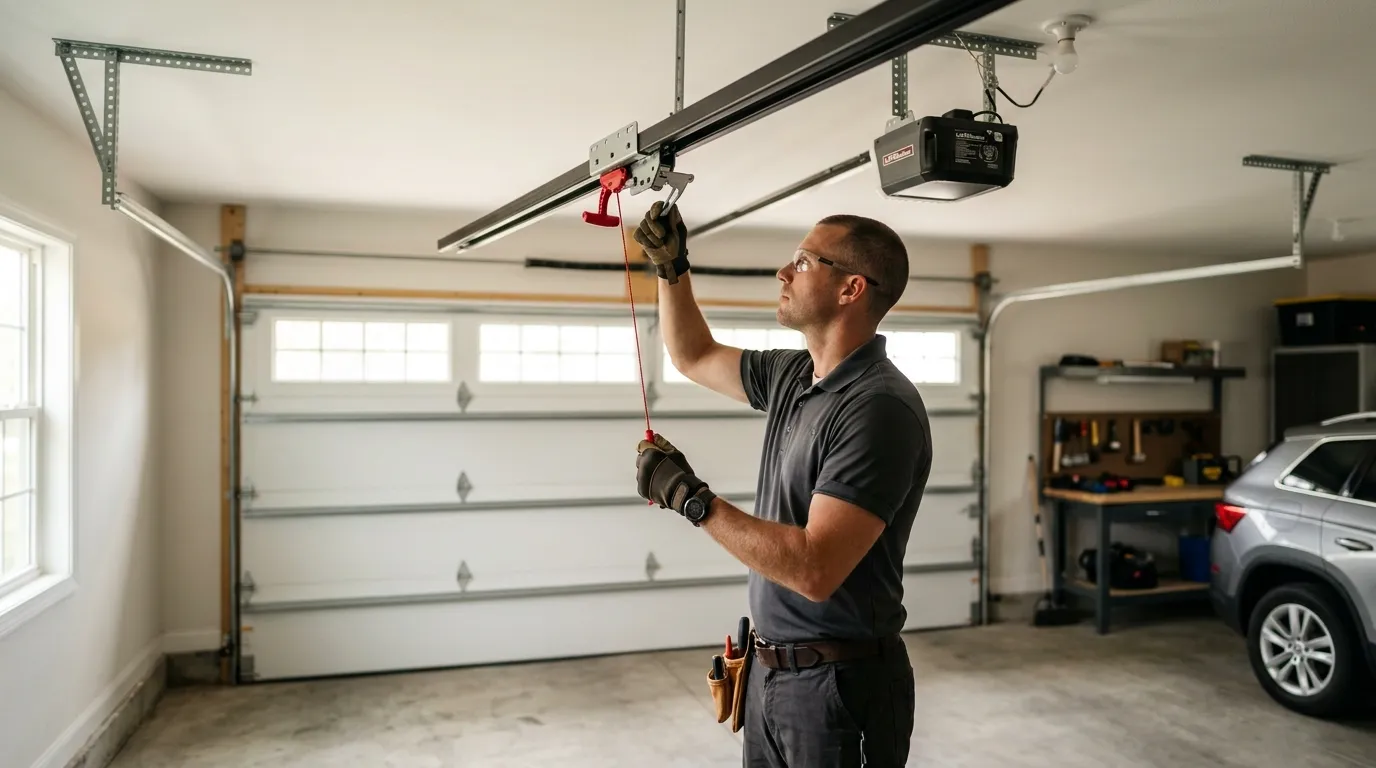
If a spring is broken, no - the door will be far heavier than it looks and can drop suddenly. If the opener itself has failed but the spring is intact, most doors have a manual release cord that lets you lift the door by hand safely. If you're not sure which situation you're in, don't force it.
Most opener problems we see on older Omaha houses are a sensor, limit switch, or gear issue rather than a dead motor. We check the actual failure point first - replacing a working motor because the remote seems unresponsive is rarely the right call.
Call now or request a free quote - same-day service on most repairs, upfront written pricing.