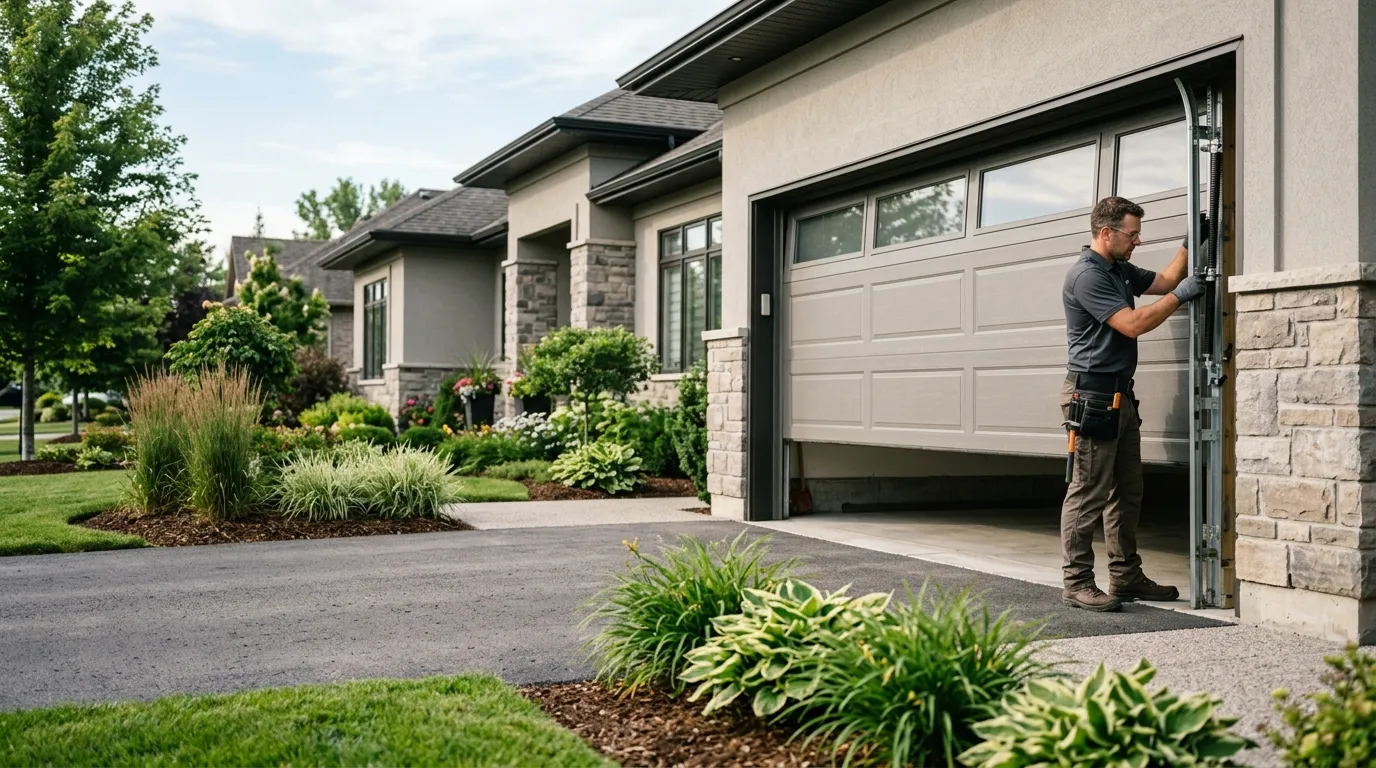
Omaha, NE · Garage Door Service
Roller replacement for Papillion's 1990-era doors, serviced from Omaha eight miles out. Nylon vs steel rollers, what fails first, and what the job actually costs.
Papillion sits eight miles out from Omaha, close enough that a roller job doesn't turn into a half-day trip, but far enough that we build the stop into a run rather than treat it as a drive-by. That matters for how the job gets priced and scheduled, not just how fast someone shows up.
We don't have a flat number to hand you here - roller jobs vary by how many rollers are shot, whether the track needs straightening too, and whether you want steel or sealed nylon. What we can tell you is which way most Papillion jobs lean. With median household income in this area running near $109,602, well above the $81,427 median across the wider service area, upgrading straight to sealed nylon rollers instead of patching worn steel ones is a call more owners here are willing to make. Nylon costs more per roller up front and runs quieter for years.
One honest limit: if your track is bent badly enough that rollers keep jumping the rail, that's a track repair or replacement problem first. Swapping rollers into a warped track just means you're back out here again in a few months.
Most houses in Papillion went up around 1990, a good decade newer than the regional median of 1982, which means you're mostly looking at nylon or steel rollers on standard steel sectional doors rather than the older steel-wheel setups still common in the parts of Omaha built before 1960. Newer track hardware, but the rollers themselves still wear the same way - grease dries out, the nylon sleeve cracks, or a steel roller's bearing seizes and starts grinding a flat spot into the wheel.
Nebraska's cold-climate swings mean the grease in those rollers stiffens every winter, and on 1990-era Papillion doors that's usually the tracks - not the springs - that show it first. A door that used to glide now shudders or hesitates a few inches off the floor. That hesitation is rollers dragging, not binding hardware.
Across the wider service area, housing stock spans 1960 through 2003 with a lot of it built in the 1980s and 90s, so Papillion's rollers are generally younger than what we pull out of older neighborhoods closer to the center of Omaha, but the failure mode - dried grease, cracked nylon, worn bearings - is the same everywhere the winters get this cold.
The roller swap itself is usually the easy part. Where it goes sideways is when a homeowner calls about "noisy rollers" and the actual problem is a cable starting to fray or a spring losing tension - both of which can mimic a rough-running door. We check those before we touch a roller, because replacing rollers on a door with a failing cable doesn't fix the noise; it just delays the real repair.
The other place this trips people up is roller size. Not every roller is a drop-in match - stem length and wheel diameter vary by door manufacturer and by how the door was installed. On a 1990s-era Papillion door, we're usually dealing with standard sizing, but if a previous repair used a mismatched part, we sometimes find that out mid-job, and that can mean a short delay while we sort the right part rather than force a fit that'll fail again in a year.
We don't carry every obscure roller variant on the truck. If your door has an unusual stem or an older wheel size, that's the one honest gap - we may need to order the exact match rather than jury-rig something close.
A straight roller swap on a standard double or single door is a same-visit job once we're on site - the door stays down for the working window, not overnight. What stretches that out is the sideways cases above: if a cable or spring needs attention first, or if a roller size has to be ordered in, the door may need to stay closed and unused until the follow-up visit.
Because the trip out to Papillion is built into a run from Omaha rather than a standalone dispatch, the window for getting parts and getting back out isn't something we can promise down to the hour here - that's scheduling, not a fact we're willing to guess at. What we can say is that a straightforward roller job rarely leaves a door out of service for more than the one visit.
If you're relying on the garage as your main entry, especially with Nebraska winters bearing down, it's worth flagging that when you call, so the job gets treated as more than a routine roller swap.
Rollers usually show up as a grinding, squealing, or juddering sound as the door moves, especially near the top or bottom of the track. A spring problem tends to show as the door feeling heavy, refusing to stay open partway, or slamming down fast. If you're not sure, it's worth having both checked in the same visit rather than guessing.
Nylon rollers run quieter and don't need grease as often, which matters given how cold snaps here stiffen grease on steel rollers every winter. They cost more per roller up front. Given the income and housing profile of this area, most owners we see here choose nylon when replacing more than one or two rollers at a time.
Usually, yes - if only one or two rollers are worn, we replace those and leave the others. If most of the set is the same age and one has already failed, we'll tell you that the rest are close behind, but the call on replacing all of them at once is yours.
No. Standard sizes for doors from Papillion's typical building era, yes. Older or mismatched hardware from a prior repair sometimes needs an ordered part, which is the one real limitation on same-visit completion for this job.
Call now or request a free quote - same-day service on most repairs, upfront written pricing.